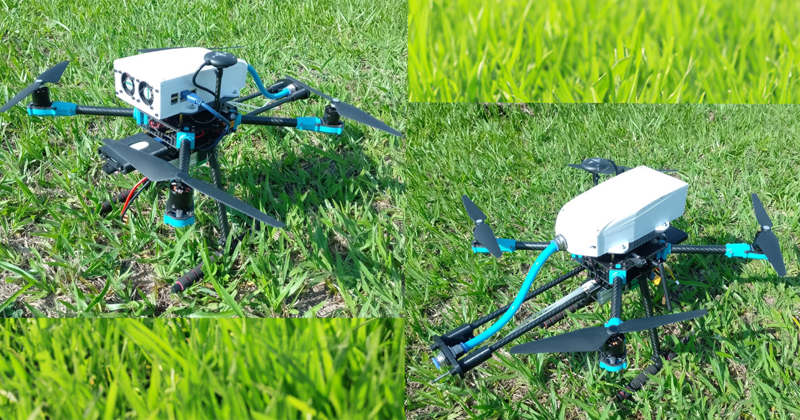
Researchers from São Carlos School of Engineering have developed an aircraft with sensors capable of detecting and measuring environmental concentrations of carbon dioxide and methane. Project was presented during Fapesp Week France

.

Forest fire prevention and control agencies in São Carlos, in the interior of São Paulo, may soon receive support to detect fire outbreaks more quickly and contain them before they grow out of control. Researchers at USP’s São Carlos School of Engineering (EESC) are developing drones equipped with gas sensors and artificial intelligence systems to identify forest fires at an early stage.
 “We already collaborate with the Civil Defense, City Hall, and Environmental Secretariat of São Carlos, and we submitted a proposal to evaluate the use of the drones we are developing to detect fire outbreaks in the municipality,” said Glauco Augusto de Paula Caurin, a professor at EESC and coordinator of the project, in an interview with Agência FAPESP.
The project was presented on June 11 during the aeronautics session of FAPESP Week France, held in the capital of the Occitanie region, in southern France.
The drones have small, low-cost sensors developed by researchers that are capable of selectively detecting and continuously measuring atmospheric concentrations of carbon dioxide and methane, as well as other parameters such as temperature and humidity, from the air flowing inside the aircraft. “We made several adjustments to integrate specific gas sensors, which work together as an electronic nose,” explained Caurin.
The gas concentration data collected by the sensors is analyzed by artificial intelligence systems, which help identify the sources of these emissions. This makes it possible to detect the presence of carbon dioxide and trace gases such as methane, which are released during forest fires and monitored during drone flights.
“Drones allow us to detect forest fires much more quickly compared to satellites, for example. This way, authorities can act faster to control them,” said Caurin.
GHG emission monitoring
Through a project supported by the São Paulo Research Foundation (Fapesp) within the scope of the Research Center for Innovation in Greenhouse Gases (RCGI), financed by the foundation in partnership with Shell, researchers have evaluated in recent years the use of drones for monitoring greenhouse gases (GHG).
The test results indicated that drones are efficient and could be a cheaper alternative compared to methods currently used for this purpose, such as satellites, research aircraft and observation towers, the researcher said. “Drones can be an alternative to these methods,” Caurin said.

.
Instead of carrying out a single flight to collect data using a research aircraft, it is possible to carry out several flyovers using drones, the researcher explained. It is also possible to better delimit a location of interest for data collection compared to satellites, which pass over and track a specific area every two days, for example.
Another advantage of using drones compared to other methods is the possibility of varying the height for data collection. “By collecting greenhouse gas data with drones, instead of an average of carbon dioxide or methane on a surface, it is possible to obtain the volume of distribution of these gases in a given region,” he says.
“Today, even with the use of the best satellites, we are unable to obtain this volumetric information. With drones, the collection of greenhouse gas data ceases to be a surface or map of the region and becomes volumetric information,” he explains.
According to him, despite their excellent performance, most commercial drones currently available can only fly for 15 to 30 minutes. As a result, they are not yet practical for surveying large areas such as forests. Through research in aerodynamics, the group aims to make the equipment more efficient, capable of flying longer and covering wider areas.
To validate the use of drones to collect GHG data, researchers carried out tests around the USP campus in São Carlos, located between a transition region between the Atlantic Forest and the Cerrado. “In the future, with better equipment, we intend to carry out missions in the Amazon,” says Caurin.
By Elton Alisson, from Agência Fapesp
English version: Nexus Traduções, edited by Denis Pacheco