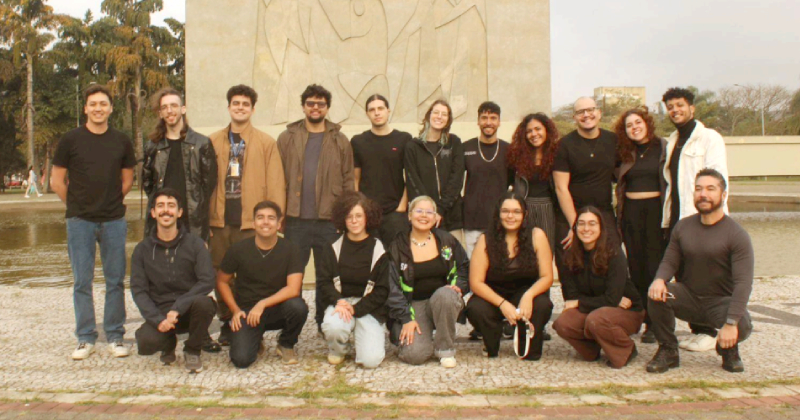
USP team earns gold medal and inclusion award at the world’s largest synthetic biology competition with a project that could reduce treatment costs for Gaucher disease

.
By: Bianca Bosso*
 The iGEM USP team earned international recognition by excelling in the International Genetically Engineered Machine Competition (iGEM), the world’s largest synthetic biology event. Coordinated by Cristiane Guzzo, from the Research Center on Bacteria and Bacteriophage Biology (Cepid B3) and USP’s Institute of Biomedical Sciences (ICB), the group presented its project in Paris, France, last week and returned with three achievements: a gold medal, a nomination among the top projects in their category, and a special inclusion award. The result reinforces the excellence of research conducted in Brazil and positions the team as a global reference in synthetic biology.
The awards recognize the Glycosy-N-ation project, developed by the team since early 2024. The proposal involves manipulating two species of microorganisms, Escherichia coli bacteria and Saccharomyces cerevisiae yeast, so they can produce human glycoproteins. One example is GCase, an enzyme naturally synthesized by the human body, whose deficiency is associated with Gaucher disease. “Today, this enzyme can already be produced for treatment using carrot, hamster, or human cells, but using bacteria and yeast could significantly reduce costs,” explains team member Davi Merighi. According to him, the team is focused on developing innovative, accessible solutions with real-world application potential, including for Brazil’s Unified Health System (SUS).
The team’s research and laboratory performance earned them a gold medal for the overall project and a nomination among the top four in the Biofabrication category, the third most competitive in the event. As the only group representing USP in the 2025 edition, the team celebrates the results as part of a solid and expanding trajectory. “These results show that we are building a promising path, expanding the team’s reach and relevance within the international scientific community,” said the iGEM USP members, recalling that the team took its first steps in 2022.

.
The group’s human-centered approach and philosophy also stood out among more than 400 projects presented, earning them the Inclusion Through Science Award. This recognition is granted to initiatives that promote diversity and accessibility in scientific research and was awarded for actions carried out alongside the Glycosy-N-ation project, such as producing a podcast on rare diseases, organizing a molecular biology workshop, hosting the event A Day as a Bioscientist in partnership with Fundação Casa, and the Araguaia Mission, an escape room adapted for visually impaired participants, held in partnership with Lar das Moças Cegas, which included hands-on activities such as modeling proteins with clay. “These achievements represent the recognition of a collective effort of excellence and reinforce our purpose: doing science with impact, responsibility, and inclusion,” emphasizes team member Guilherme Pompeu.
In addition to the supervision of Cristiane Guzzo, the team also includes the collaboration of ICB researcher Mário Henrique.
More than six thousand students
The International Genetically Engineered Machine Competition (iGEM) is the world’s largest event dedicated to synthetic biology. Created in 2003 by the Massachusetts Institute of Technology (MIT), the competition annually brings together more than six thousand students from various countries to foster the development of innovative solutions to social and environmental challenges using biology as a technological tool.
The team dedicated the iGEM 2025 Inclusion Award to Lar das Moças Cegas and Fundação Casa, recognizing the joint effort to promote inclusion and accessible scientific education. The group thanked the professors and institutions that supported the Accessible Escape Room project, as well as USP, Fapesp, and partner companies that enabled its development.
Meet the iGEM USP team at this link.
*From the Cepid B3 Communication Team
English version: Nexus Traduções, edited by Denis Pacheco